
2026 Best Practices: Social Media
Posted on January 8, 2026
Happy New Year!
As we move into 2026, it’s a good time to renew our commitment to effective digital communication. As representatives of important government agencies, it’s our duty to pay attention to ALL our digital messaging.
That includes the often-overlooked platform of social media.
Here’s a quick breakdown of some civic tech social media best practices, based on three concepts: Tone, Technique, and Direction.
Tone
- Write posts in plain language, aiming for a reading level accessible to most people. Statistically, this means writing nothing more complex than an 8th-grade reading level. If you aren’t sure whether you’re accomplishing that, consider using a free readability checker like the Hemingway app to review your text:
Free Readability Checker App | Check readability score of your text
- Make sure you keep your social media accessible, as we discussed in a recent post. This includes making sure any information that’s in the image is also included in the caption.
- Don’t be too familiar; your audience is the public, not internal staff, not your friends or family.
- Speak to residents’ needs, not agency priorities (“Here’s how you can…” vs. “Our department is proud to…”).
- Keep tone steady and responsible— especially during sensitive issues or public scrutiny.
Technique
As a government entity, your social media accounts are in constant competition for attention. Many commercial outlets have huge marketing teams and can pay to get their content to be recommended ahead of yours.
Here are a few tricks to help get your posts noticed:
- Facebook and Instagram now prioritize shares and saves over likes. Try to make sure your content affects a wide audience and can be easily sharable.
- Keywords in the captions of Instagram and Facebook help content get recommended.
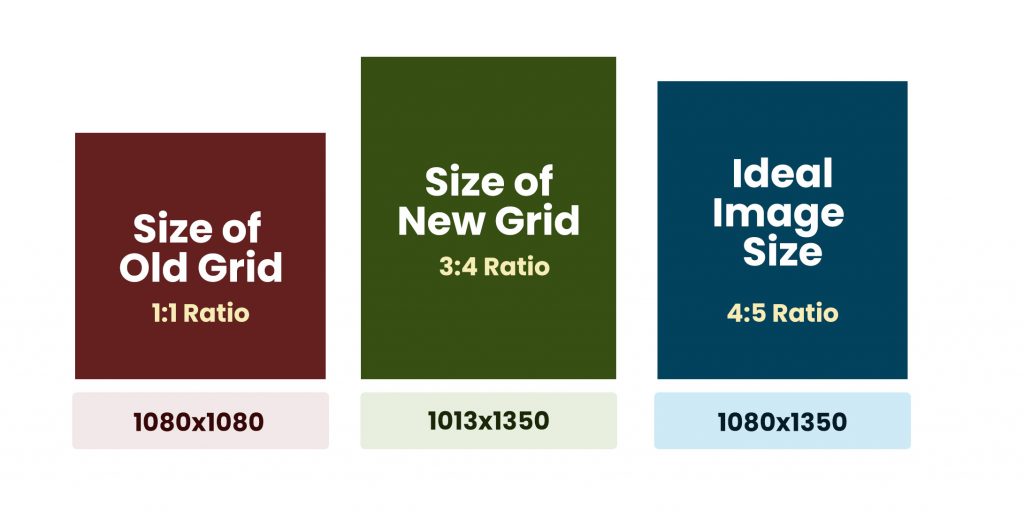
- This past year, Instagram changed its longtime grid image size from a square 1:1 ratio to a more vertical 3:4 ratio. HOWEVER, it is recommended to ideally crop your images to a slightly shorter 4:5 ratio (1080×1350 px). That’s because this 4:5 ratio is what will appear in the grid view, which is the preview format that anyone scrolling will see.
If you create a post in a square or landscape, your image will be cut off of view. This is particularly a problem with graphics that include text.
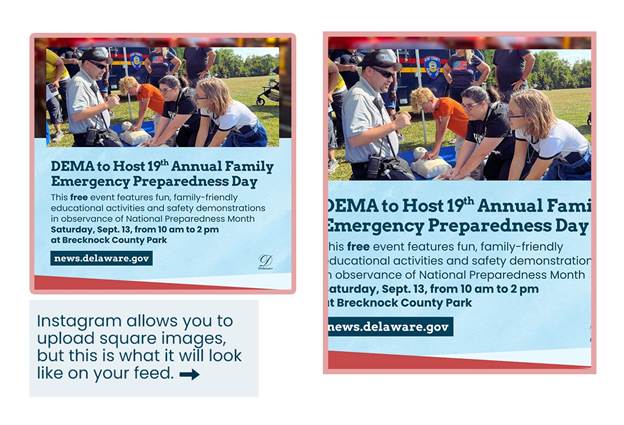
Image dimensions don’t matter as much on Facebook, because there is no “grid”. So, you can use the same size as IG to make your life easier.
- Remember that not everyone will be able to watch a video you post with audio. Make sure you have captions in place as well as having the most important key points in your post text.
- Depending on the message, it may be wise to both create a video as well as another post that is graphic focused with the same info. Posting multiple times in multiple mediums will give you more opportunities to lift up your content.
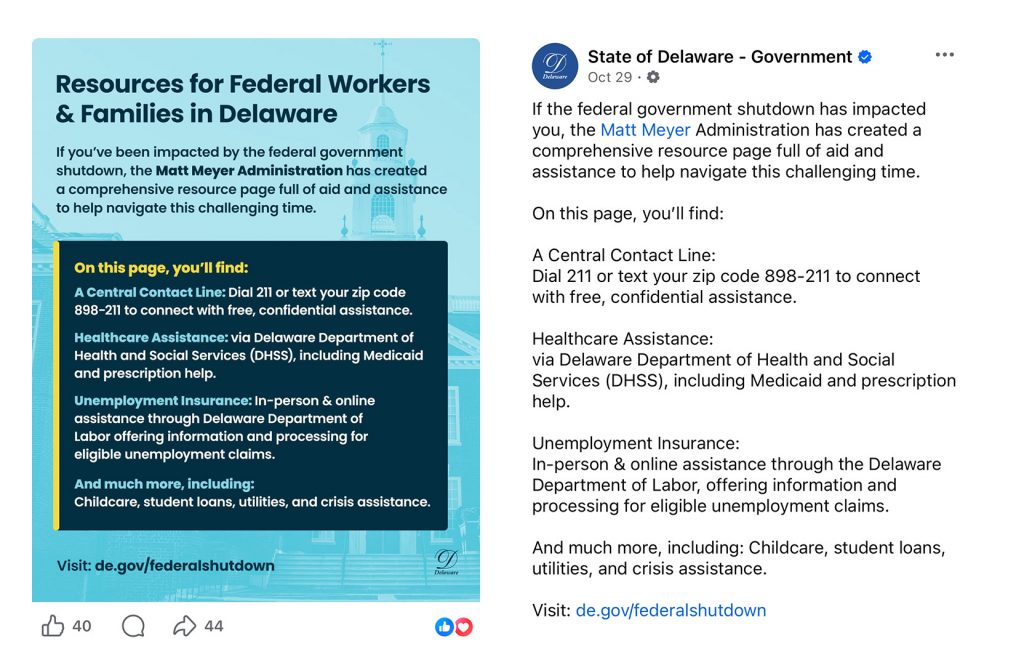
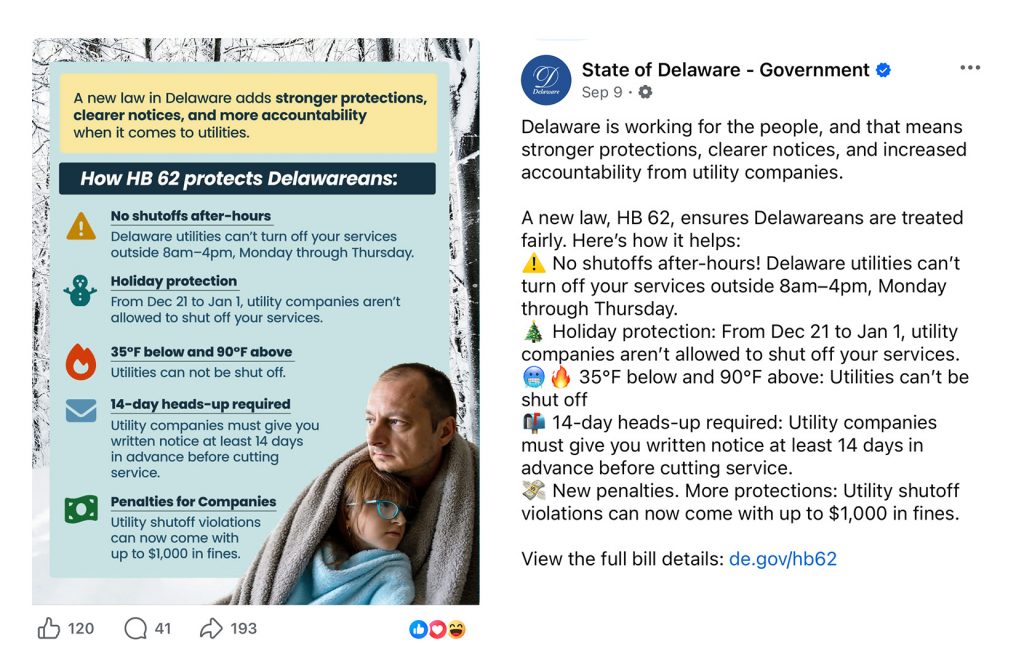
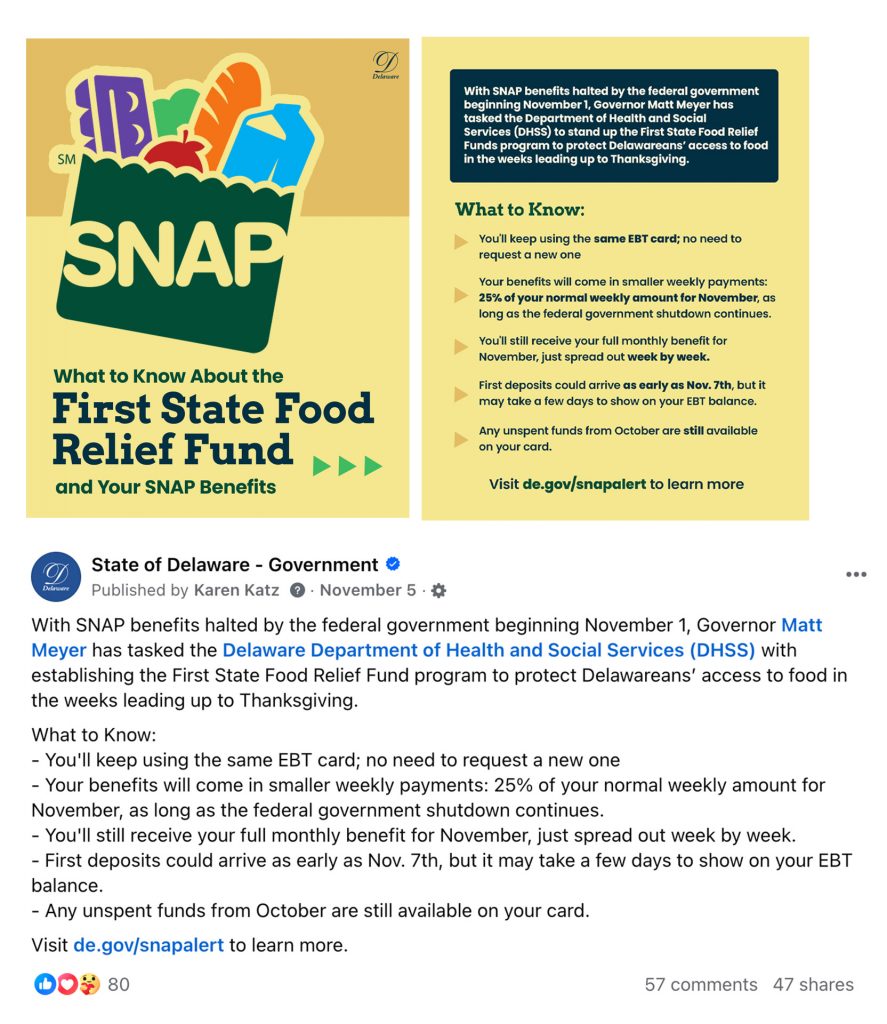
Here is an example of a video that was posted by the Department of Health and Social Services about the recent suspension of SNAP benefits:
https://www.facebook.com/share/v/1BuvQuExXP/
And here is the accompanying graphic version of the same information:
Direction:
- Intentional planning leads to better communication; Develop a content strategy tied to agency goals and public needs.
- Build a calendar to prepare for events, closures, holidays, and to prepare evergreen content for downtimes.
- Align with statewide initiatives when relevant, including themes like services, programs, public safety, announcements, events, community education, and success stories.
- Monitor reach, meaningful comments, link clicks, response timeliness, and whether communication supports public outcomes (attendance, applications, awareness).
- Be mindful that content may be subject to FOIA requests—write with accountability in mind.

Social media is an increasingly important way to reach people where they are. In the five years between 2020 and 2025, the total number of global social media users increased from an estimated 2.95 billion people to 5.41 billion people. That’s an 83.4% increase in just five years. (Source: Pew Research Center)
As government agencies, we used to have to wait for people to come to our offices. Eventually, we were able to reach them at their home computer. Now, it’s increasingly important to reach them on mobile devices, where the majority of the scrolling occurs. Your agency is likelier to get new visitors through social media than through traditional search engines.
Remember: Social media is an important frontier in the expansion of public service. It also represents a tremendous opportunity to connect with Delawareans!
Stay Updated
Receive the latest news from the GIC.